Knitting for Absolute Beginners: Choosing Your First Yarn, Needles and Pattern
A plain-English starter guide to knitting: choose a forgiving first yarn, match it to the right needle size, and knit a simple garter-stitch scarf.
The first row is always the clumsiest. Most people who abandon knitting do it within an evening — not because the craft is difficult, but because they started with a slippery novelty yarn and needles that fought back. Get three things right and the whole business turns calm and rhythmic: a forgiving yarn, needles that suit it, and a pattern written for someone who has never knitted a stitch. None of it needs to cost much.
Choosing yarn you'll actually enjoy knitting with
For a first project, look for double knitting (DK) or aran weight yarn in wool or a wool blend. Both are thick enough to see your stitches clearly and springy enough to hide small wobbles. A light or medium colour helps enormously: navy and black swallow the stitch definition you are trying to learn from.
Look closely at the yarn before you buy. A smooth, plied yarn — two or more strands twisted together — is far easier to work with than a single strand that splits as you push the needle through it. Avoid fluffy mohair, eyelash yarn, ribbon yarns and anything sold as novelty yarn. They are lovely in experienced hands and miserable in beginners'. Cotton is worth postponing too: it has little stretch, so every slightly tight stitch shows.
Buy one or two balls, not a basketful. If you are torn between two options, choose the one you would happily wear against your neck.
Yarn weights and the needles that suit them
Yarn comes in standard weights, and each has a needle size that generally works with it. In the UK you will see them described like this:
- 4-ply (fingering) — 3.25–3.5mm needles. Fine and slow, and unforgiving of uneven stitches. Not a good first choice.
- DK (double knitting) — 4mm. The beginner's sweet spot: quick enough to show progress, chunky enough to see what you are doing.
- Aran or worsted — 5mm. Grows quickly and shows stitch patterns beautifully.
- Chunky — 6–6.5mm. A scarf appears in a few evenings, which is exactly the encouragement most people need.
- Super chunky — 8mm and above. Very fast, but the yarn is often expensive and mistakes are large and obvious.
Every ball band prints a recommended needle size and a tension figure. Treat that as a starting point, not an instruction — your own knitting may sit either side of it.
Needle size, material and the small extras
UK needle sizes are given in millimetres. Older patterns use numbers, so a conversion chart is worth keeping in your bag. For a first scarf, straight needles around 35cm long are plenty; longer ones get in the way of small projects.
Which material?
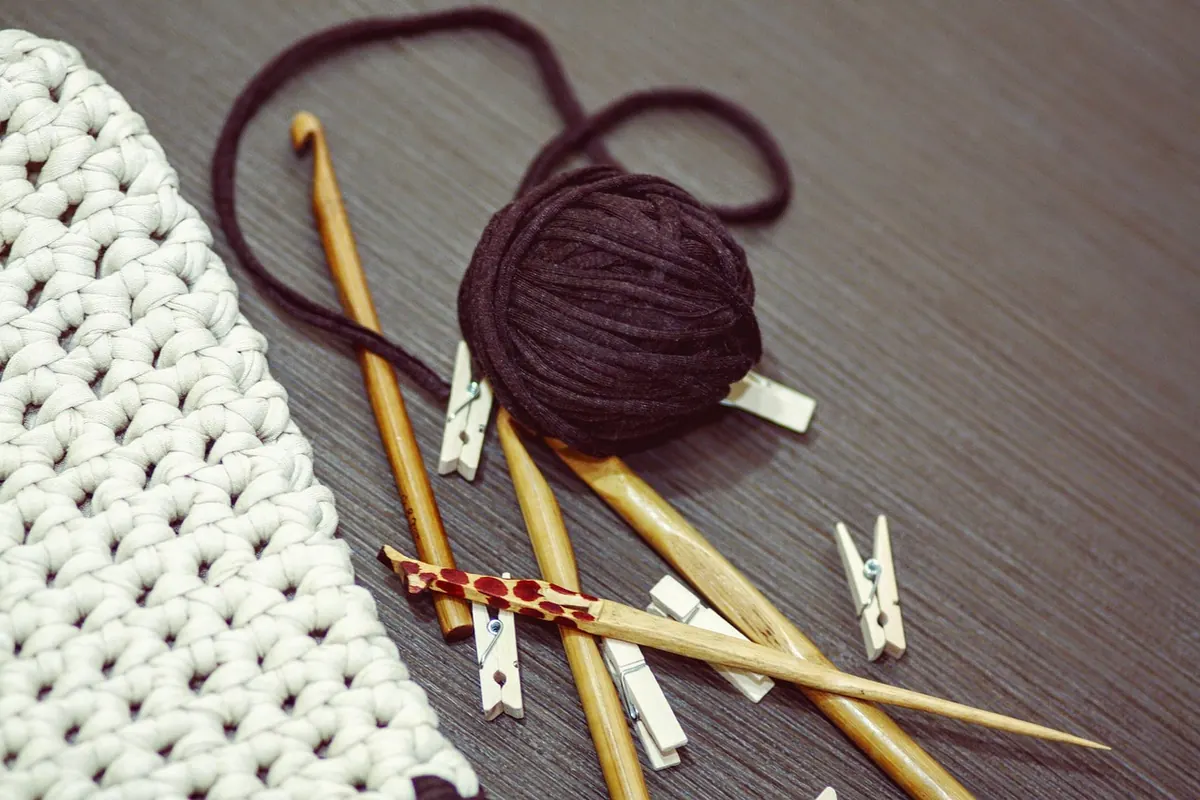
Bamboo or wood grips the yarn slightly, which is reassuring while your hands are still learning the movements. Metal is slick and fast — good once you are confident, frustrating before that. Plastic is cheap and light, but bends under pressure.
Circular needles are worth knowing about even if you never plan to knit in the round. A circular needle holds far more stitches than a straight one and rests comfortably in your lap, which many knitters prefer for scarves and blankets.
A few small things make the first month easier: two or three stitch markers, a blunt tapestry needle for sewing in ends, and a pair of snips. Skip the interchangeable sets and the bundles containing every size for now. Buy what the current project needs.
Tension squares, and why the first one is worth it
Everyone knits at a slightly different tightness. Knitting tension — often called gauge — is simply how many stitches and rows you produce in 10cm. Patterns are written around one figure, so if yours is different, the finished piece comes out the wrong size. It matters more for a jumper than for a scarf, but learning the habit now saves trouble later.
Knit a small square: cast on 30 stitches in DK on 4mm needles, knit every row until the piece is roughly square, then cast off. Lay it flat — and if you can bear to, wash it and let it dry, because some yarns relax with water — then measure 10cm across the middle and count the stitches. More stitches than the ball band suggests means you knit tightly, so go up a needle size. Fewer means you knit loosely, so go down. Keep the square as a coaster.
Your first project: a garter-stitch scarf
Garter stitch — knit every stitch, every row — is the simplest fabric there is. It lies flat, looks the same on both sides, and forgives an uneven first attempt. The same skill makes a coaster-sized square or a full scarf; the only difference is how long you keep going.
- Choose a DK yarn in a light colour and a pair of 4mm bamboo needles. Buy all your balls from the same dye lot, as shades can vary between batches.
- Cast on 30 stitches. If you have not learned a cast-on yet, the knit cast-on is the kindest to keep even.
- Knit every stitch on every row. That is the whole pattern.
- Count your stitches at the end of each row for the first ten rows. A dropped stitch is far easier to fix immediately than three rows later.
- Keep going until the scarf is as long as you want, leaving roughly four times the scarf's width in yarn for casting off.
- Cast off loosely — a tight cast-off will not stretch — then weave the ends in with a tapestry needle.
If your edges look wobbly and your first rows are looser than your last, that is normal. Tension evens out with repetition, not with corrections.
Where to go next
Once garter stitch feels automatic, learn the purl stitch. Combine the two and you have stocking stitch and ribbing, which between them account for most of the knitting you will ever see. A local yarn shop or a knitting group will answer in five minutes what a video takes an hour to explain, so it is worth finding one.
Keep your first piece, however lumpy — it is a useful record of how far you have come. And if you have existing hand, wrist or shoulder trouble, knit in short sessions, take breaks, and speak to a GP or physiotherapist about any pain that does not settle.
Photo: 742787 / Pixabay